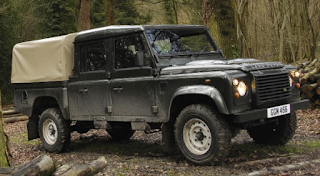
Land Rover Defender ends production

 http://truckncar.blogspot.com/Land rover defender
It is a vehicle that enjoys as much affection as other motoring icons, like the VW Beetle, the Ford Mustang or the original Mini -- but this week, Land Rover is finally turning off the production line for the Defender, the car that lent its name to the company.
For the Defender did that and more; its demise brings to an end a vehicle that can be traced back to 1948, when a car known simply as the Land Rover went on sale in a bid to raise enough cash to restart mainstream car production at Britain's Rover brand.
The new creation, designed primarily for farmers and the military, had an expected shelf life of a few years. However, when its sales comfortably outstripped those of regular Rovers, the Land Rover standalone brand was born.

Lack of tools inspired boxy design

The inspiration for the Land Rover was the original Willys Jeep -- chief designer Maurice Wilks had an example of the American vehicle on his farm in Wales -- but post-war Britain had a number of limitations that affected the design.
Chief among these was the use of lightweight aluminum for the body panels; the designers' hand was forced by the shortage of suitable steel, not to mention a lack of the pressing tools required to bend any curves in the metal.
The slab-sided aluminium's resistance to corrosion brought a useful side effect: it is no coincidence that two-thirds of the two million-odd Land Rovers ever built are reckoned to still be on the road. And off it, if you catch the drift.
It would be unfair to say that the Land Rover has not been developed over the years. Larger, more powerful engines have been introduced, along with plusher trim and a few creature comforts.
It even gained a new name, the Defender, when Land Rover started expanding its line-up with mainstream products like the Discovery and Freelander.
The final limited-edition Defenders, which included a retro-styled version, including heated seats, air-conditioning and even a CD player.
Yet these elements alone could never overcome the car's unshakeable core: a simple chassis layout with a boxy, straight-panelled body and a four-wheel drive system honed on British farmland but equally capable in tropical Africa or the Arctic Circle.

How the Defender became a British cultural icon

For Britons, the Land Rover has become a beacon for durability and dependability -- a tool of the establishment, used by the police service, the coastguard and armed forces, but also politicians, vets, and rock stars.
However, almost 60 years on, crash test legislation and emissions laws have finally killed it off.
It has been the choice of Royals on state visits, and the daily drive of the Queen herself when she's on holiday in Scotland. In the enormously successful Bond movie Skyfall -- as strong a British cultural export as you can find these days -- the return of a classic Aston Martin DB5 caused headlines, but the best car chase in the flick featured an increasingly battered Defender.

Easy to replace?

What next? A replacement isn't likely for at least a couple of years - a sign, perhaps, of how tricky Land Rover's product department is finding it to replace the company's icon.
Such is the car's cultural significance that as successor is seen as a core part of Land Rover DNA -- a figurehead whose presence legitimizes the off-road ability of posher stablemates like the luxurious Range Rover and the Evoque baby SUV.
Yet it has to wash its own face in profit and loss, and the creation of a rugged, capable, go-anywhere vehicle with the flexibility to be a convertible, a pick-up, a troop carrier, an ambulance, a farmer's workhorse or a family car, while complying with global vehicle rules and making money, is not an easy one. It took a slice of pure British luck to create the Land Rover; it may well take another one to replace it.
Read More

tips for safely back over truck

 http://truckncar.blogspot.com/back over
From 2005 to 2010, dump trucks, semi-trailers, trucks, forklifts, garbage trucks and pickup trucks were involved in nearly 200 workplace backover deaths, according to OSHA. Additionally, the Bureau of Labor Statistics recently began collecting specific information on these fatalities and determined that 79 backover deaths occurred on the job in 2011.
A backover incident occurs when a backing vehicle hits a worker who is standing, walking or kneeling behind the vehicle.
The following are examples, recommended by OSHA, of back-over prevention methods:
Spotters: Using a spotter has been proven to keep the safety of workers. However, spotters also are in danger of being hit by a backing vehicle. Several steps can be taken to help keep workers safe.
  • Before work begins, drivers and spotters should agree on hand signals.
  • Ensure spotters always have visual contact with the driver when a vehicle is in motion.
  • Ensure drivers know to stop immediately if they lose sight of a spotter.
  • Do not give additional duties to spotters.
  • Do not allow spotters to use mobile devices or personal headphones when working.
  • Provide high-visibility clothing for spotters, especially when working at night.
Cameras: OSHA states that most vehicles can accommodate a camera to provide drivers with a view to the rear and other blind spots. When equipping vehicles with cameras, it is important to consider the environment operators work in. Some construction sites and mines may require more rugged cameras, and vehicles such as dump trucks may need two or more cameras to monitor blind spots.
Proximity detection systems: These systems use radar and ultrasonic technology to bounce a signal off an object. The system then alerts the vehicle operator with a visual or audio warning that an object is in the way.
Internal traffic control plan: Create a plan to coordinate the flow of moving equipment, workers and vehicles to help minimize the number of times workers and vehicles cross paths. According to OSHA, these plans can significantly reduce and even eliminate the need for vehicles to back up on a jobsite
Read More

Tips For Driving Trucks Safely

In the classification of commercial motor vehicles (CMV's), trucks range from very large oversized trucks all the way down to small straight trucks. In order to drive these CMV's, people in the US must have a commercial driver's license (CDL) to drive trucks over a Gross Vehicle Weight Rating.

Components of a commercial driver's license test consist of both a skills test and a general knowledge test. The driver must show skills in making turns, backing up, stopping, driving on both highway and city roads, or weaing through a serpentine course. Commercial drivers licenses are available in Classes A, B, and C, and only Class A holders can operate the large trucks.

The first safety tip for truck drivers is to establish a cushion of space in all dimensions. Make sure to keep tabs on the heights above the truck (e.g. overpasses) along with road surfaces (e.g. road hazards, pot holes, or speed bumps). In addition, ensuring adequate forward and rear space for necessary quick stopping along with adequate turning radiuses will increase safety as well.

Researching travel conditions prior to a trip (such as weather and traffic) will lead to safer driving decisions. This may allow one to avoid inclement weather and a potential accident. Also, increased traffic may lead to impatient drivers and bad decisions which can cause an accident putting one's truck safety at risk.

Another part of planning is pre-trip inspections. Routinely having maintenance performed will prevent potential problems with tires, axles, fluids, etc.

Driving at safe speeds can prevent fatalities. After all, the National Highway Traffic Safety Administration reported speeding as the #1 factor in fatal large truck crashes in 2009. It always takes longer to brake a large truck than a car, so the safe driving speed and cushion is extremely important.

If safe speeds are stuck with, the truck's tires can maintain sufficient traction during a necessary quick slow down. Driving at night, on hilly or mountainous areas, on curving roads, or whenever rain is falling can make it difficult to stop safely. Total stopping distance is equal to the sum of perception distance, reaction distance, brake lag distance, and effective braking distance. Adverse weather will lengthen the total stopping distance.

Contrary to a typical car driver, those in a truck need to look much farther down the road since it takes so much longer for a truck to stop effectively. It is also not a great idea to rely blindly on GPS routes when it comes to clearance under bridges and overpasses. Just because the GPS says it is the shortest route, the top of your truck may not be so happy when it is gone.

When backing up, remember a truck is not a car. There are significant blind spots with a truck while backing up so the acronym G.O.A.L. is important - Get Out And Look. Having plenty of mirrors on a truck on each side can decrease the size of any blind spots. This may mean 3 to 5 on each side.


Read More

Ford Ranger utility range


FORD’S one-tonne ute has done well since its arrival in 2007, keeping up in the sales race with all of its key competitors except for the leader of the pack, the Toyota HiLux.

Now, a styling refresh and additional models have been overlayed on a mechanical and body specification essentially unchanged from the PJ Ranger series introduced just two years ago.

The Ranger still has obvious hangover components from its predecessor, the Courier, such as the umbrella handbrake, but there’s nothing old-school about the Ranger’s engines or chassis dynamics.

THE Ford Ranger was released early in 2007 with new engines, transmission and body fitted to a revised ladder chassis.
The Ranger replaced the Courier, with the new nameplate becoming available to Ford when another manufacture’s right to use the name in Australia expired.

Ford dispensed with the Courier’s petrol engine for the new Ranger, instead offering an entry-level 2.5-litre TD produces 105kW and 330Nm and a 3.0-litre TD that pumped out 115kW and 380Nm.


View the original article here
Read More

When Your Big Rig Truck Needs Repairs

Are you thinking of some ways to earn? Are you thinking of a big rig truck as a great investment? If you are thinking of owning a big rig truck and operating your own company then you may consider taking action right now. Certainly, you can earn or gain profit while driving a truck when you are a commercial owner-operator.
There is no question about that but there is a little problem that if neglected can become a major disaster. It's when your big rig truck needs repairs.You must be aware that every time your truck needs repair, you also need additional expenses.
Panic comes for new operators when they don't have enough spare funds to supply the repair needs. In other words, operators need to anticipate unpredictable scenarios that may happen and they should have other sources to support the needed costs. Unfortunately, a lot of operators end up getting bad credit scores because of struggling to pay for the repairs ending up in a very bad debt.
But good thing there are money lenders who can offer you loans and funds to back up the future expenses. Banks can even offer you loans as long as you take full responsibility of your debt and loan. You could set for a private loan or a secure loan depending on the amount of big rig repair needed for your heavy truck. Funds really are not that hard to find as long as you open your mind to ideas and ways that you can think of.
Another thing that you can consider when your big rig truck needs repairs is the repair service offered to you. Almost everyone seems to understand that a successful repair can only come from the right mechanic. In simple terms, when you select for a mechanic, make sure that he is an expert and knows about the technicalities of your truck. Remember, the one that keeps your business or company in action is your truck - not your products and not even your resources.
The moment you choose for the right mechanic is the same event that you give a successful repair for your big rig truck. And in order for you to determine the right man to repair your vehicle that moves your company in action, you need to ask questions. Ask questions that concerns more about how he would repair your truck. When the mechanic can answer your questions in a confident manner then you can be confident.
But even if there will be lots of challenges ahead in terms of repairs especially on the costs that will be involved, you should not fall back in thinking for investing for a truck and operate a company. If it's your dream you need to find ways and do whatever it takes. If you had bad experiences before then settle the accounts and forget about the mistakes done. You get to move on and let go of the past and venture for a big rig truck.


View the original article here
Read More